Most Western travelers equate speed with efficiency. We measure a good trip by how much we manage to fit in, how quickly we move, and how seamlessly we get from one highlight to the next. Japan, with its famously punctual trains and lightning-fast Shinkansen, seems to reward this mindset.
But Japan quietly offers a different kind of luxury—time.
Some of the country’s most memorable moments don’t happen at temples, restaurants, or observation decks. They happen in between. Through a train window. In the pause between stations, where landscapes unfold slowly enough for you to notice how they breathe.
In Japan, trains are not just designed to get you somewhere. Many are designed to be experienced.
Further reading: Must Know Travel Tips for Foreigners in Japan
The Shinkansen Is Impressive—But It Isn’t the Whole Story

The Shinkansen deserves its reputation. It is fast, smooth, silent, and almost unnervingly precise. It reflects Japan at its most engineered: speed without chaos, efficiency without friction. For long distances, it is unmatched.
But that very perfection comes with a tradeoff.
At 300 kilometers per hour, the country compresses. Mountains become silhouettes. Towns dissolve into sound barriers. You arrive rested, on time, and slightly disconnected from everything you passed through to get there.
Local and regional trains operate on a different philosophy. They are less concerned with conquering distance and more with accompanying it. In Japan, there is a subtle cultural distinction between getting there and being there. The Shinkansen excels at the former. Scenic local lines quietly excel at the latter.
Local Trains: Where the Landscape Slows Down

On local trains, the experience changes almost immediately. Stations are smaller. Announcements are fewer. The windows feel more important than the clocks. You begin to notice how neighborhoods shift into farmland, how forests creep closer to the tracks, how coastlines appear without warning.
These trains don’t rush you past Japan—they introduce you to it.
You pass through places that aren’t destinations in any guidebook. Residential streets, fishing towns, factory edges, rice fields stretching out in careful grids. The train becomes a moving seat in someone else’s everyday life, not a tourist conveyor belt.
That intimacy is the point.
Where the Train Window Matters More Than the Timetable

Along the Gonō Line, which runs beside the Sea of Japan, the tracks trace the coastline so closely that water and sky begin to blur together. On quiet afternoons, the ocean feels close enough to touch. There is no dramatic announcement, no viewpoint platform—just long stretches of blue, seen in motion.
Outside Wakayama, the Kishigawa Line moves at a gentler pace still. Schoolchildren climb aboard with backpacks. Elderly passengers greet the driver by name. The scenery is modest—suburban streets, small shops, open fields—but deeply grounding. This is not Japan performing for visitors. This is Japan as it functions.
These are trains where the windows matter more than the timetable, and where the passing view feels less like scenery and more like participation.
Seasonal Rail Journeys That Change Japan Entirely

Japan’s seasons don’t simply change the landscape—they rewrite it. And nowhere is this more apparent than from a train seat.
Winter: Snow, Silence, and Northern Lines
In winter, rail travel becomes almost cinematic. Snow-covered villages sit quietly beside the tracks. Platforms are empty, sound absorbed by white landscapes. Inside the carriage, the train becomes a warm, moving observation deck, gliding through stillness.
Winter trains feel private. Intimate. As if you’ve arrived during a pause rather than a peak. For travelers willing to embrace the cold, winter rail journeys reveal a Japan that feels hushed, patient, and deeply personal.
Spring: Cherry Blossoms Beyond the Famous Spots
Cherry blossom season is often imagined as crowded parks and carefully planned picnics. But from a train, sakura appears differently.
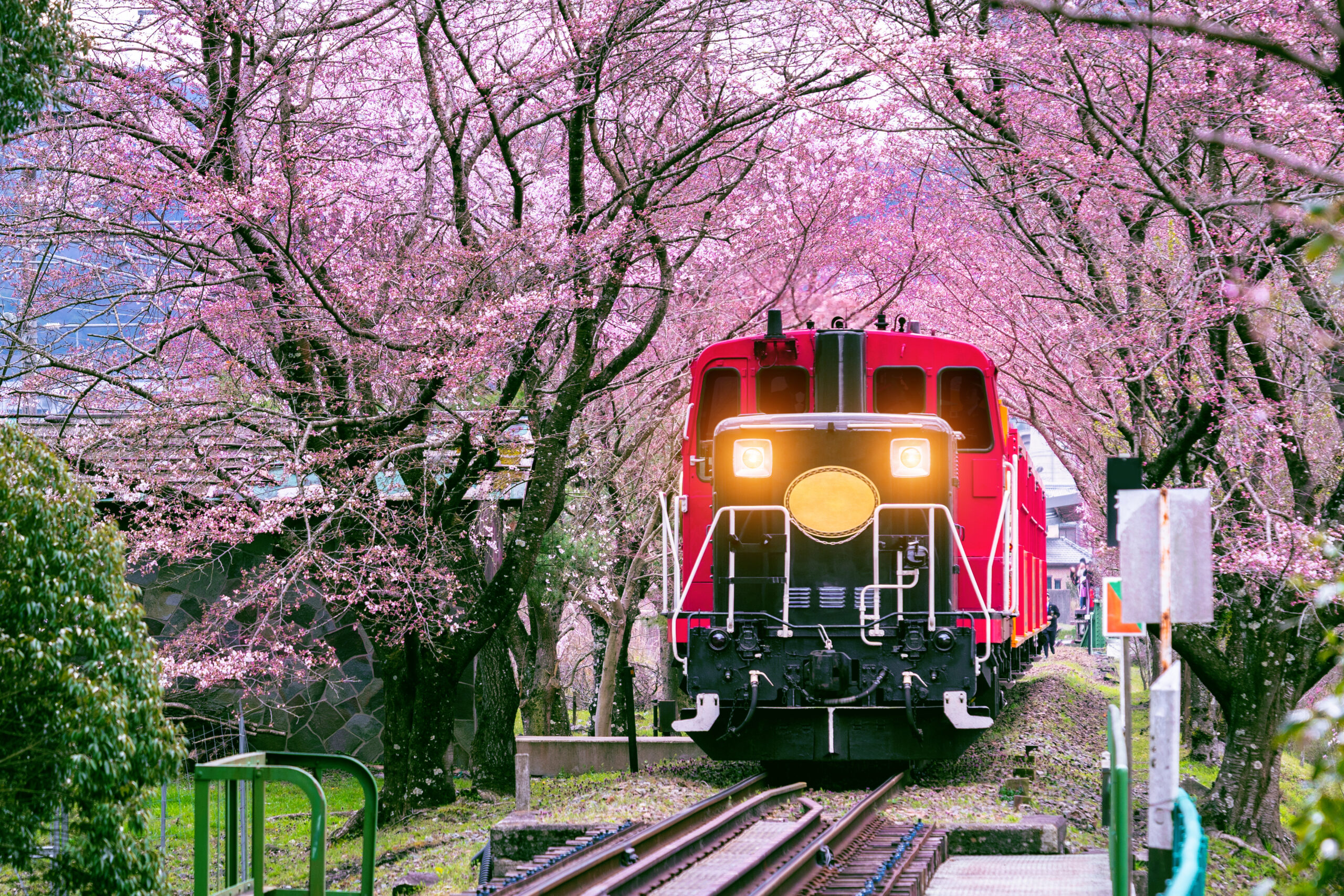
Tracks run through tunnels of pale pink. Blossoms line rivers and backyards rather than landmarks. Trains offer fleeting, repeated views rather than a single perfect moment. You don’t stop for the blossoms—you pass through them.
This kind of viewing rewards patience and timing, not proximity. It turns the act of moving into the experience itself.
Autumn: Slow Fire Through the Mountains
Autumn may be Japan’s most underrated season for train travel. From river valleys and mountain routes, foliage unfolds gradually. Greens deepen, yellows soften, reds arrive last.
The motion of the train enhances the effect. Light shifts. Colors layer. The landscape doesn’t present itself all at once—it reveals itself slowly, and only if you stay seated long enough.
When the Journey Becomes the Destination

Some routes in Japan are ridden without urgency. People board without checking when they’ll get off. The purpose is not arrival, but presence.
Japanese rail design often supports this mindset. Observation cars, large windows, slower speeds through scenic areas—these are not accidents. They suggest that movement itself can be meaningful.This may explain why some stations exist in places with seemingly little around them. Sometimes the view is the reason. Sometimes the pause matters more than the place.
Why Tourists Rarely Plan These Routes (and Why You Should)
For many visitors, these trains remain invisible. Their names are unfamiliar. Their routes don’t appear in bold print. Navigation apps prioritize speed, not experience. There’s a quiet fear of wasting time—of choosing beauty over efficiency.
Language anxiety plays a role, too. Local lines feel less predictable, less packaged.
Yet Japan’s rail system is built on trust. Trains run when they say they will. Connections are forgiving. Staff help without hesitation. Even when plans shift, the system absorbs the change.
What feels risky on paper often feels remarkably calm in practice.
How to Add a Scenic Train Ride to Your Itinerary Without Replanning Everything

You don’t need to redesign your entire itinerary to experience this side of Japan. Often, it’s as simple as slowing down one segment of your trip.
Swap one Shinkansen leg for a regional line. Choose a scenic route as a connector rather than a detour. Let weather and season—not just distance—guide a single travel day.
One slower ride can recalibrate the rest of your journey.
The Kind of Japan You Only See Through a Train Window
From a train, Japan reveals itself quietly. You see how towns wake up, how fields are tended, how daily life moves at a human pace. No signs are telling you what matters. You decide that for yourself.
These moments liner because they are unannounced. They don’t ask for attention, yet they stay with you longer than many landmarks ever will.
In a country famous for speed, choosing to travel slowly can feel radical. But in Japan, it often feels like the most natural choice of all.
And sometimes, the most meaningful part of the journey isn’t where you arrive but what you notice along the way.
Further reading: Traditions in Japan You’ll Experience Without Realizing It