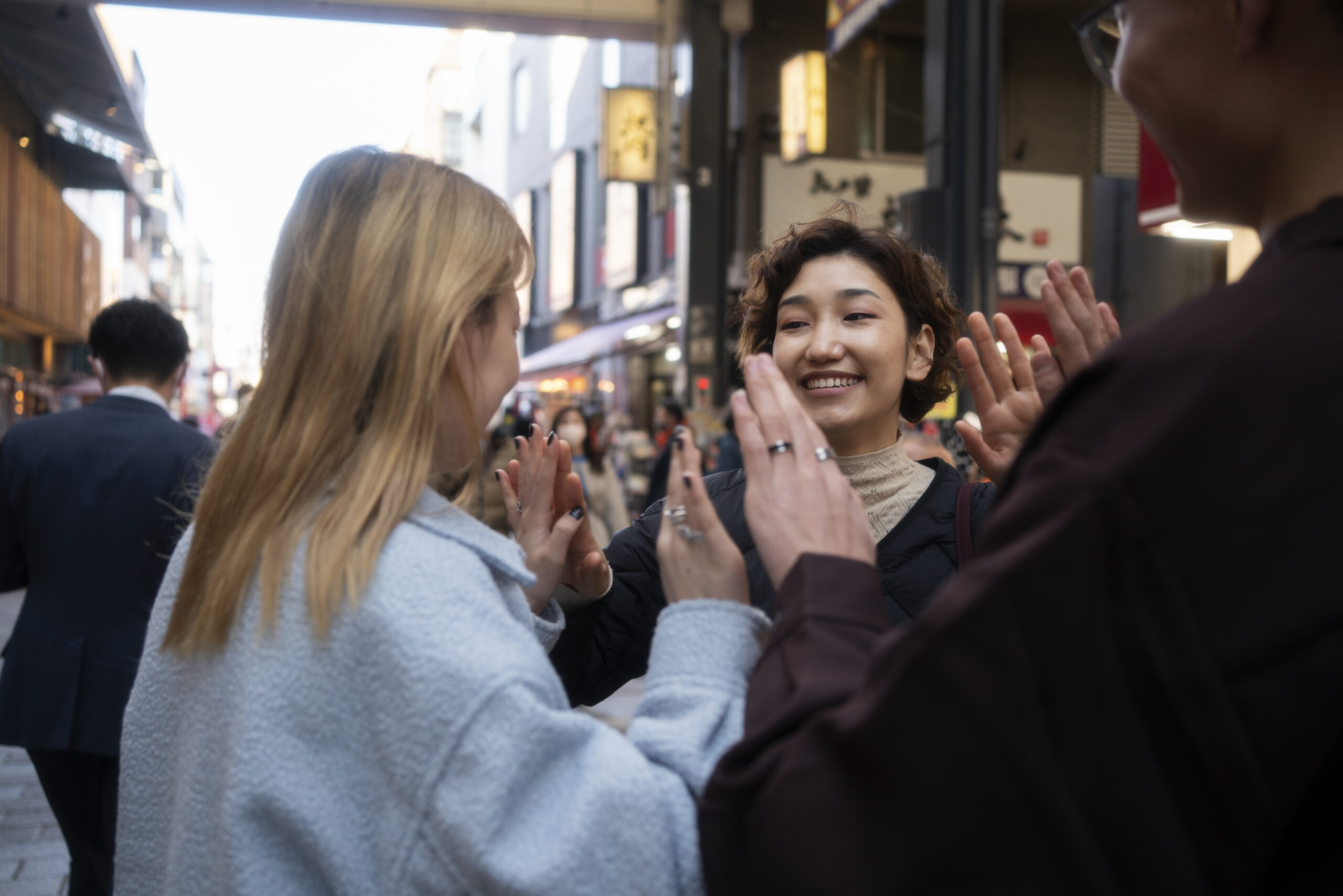
There is a moment that almost every foreigner in Japan eventually encounters. A colleague smiles and says, “That sounds interesting,” and yet something in the air suggests otherwise. A dinner invitation is met with “Let me check my schedule,” and the follow-up never comes. A friend says they are fine, and clearly they are not. At first, this feels like a mystery. Later, it begins to feel like a different language entirely—one with no dictionary and no formal lessons. What you are navigating is one of the most fundamental dynamics in Japanese social life: the quiet coexistence of honne (本音) and tatemae (建前).
Understanding these two concepts will not give you the cheat code to Japanese culture. But it will change the way you read a room, interpret silence, and appreciate the profound social intelligence woven into everyday Japanese interaction.
Further reading: 10 Unwritten Social Rules in Japan Every Foreigner Should Know
What Do Honne and Tatemae Actually Mean?
The words themselves offer a useful starting point.
Honne (本音) is composed of hon (本), meaning “true” or “real,” and ne (音), meaning “sound” or “voice.” Honne is your real voice—what you actually think, want, feel, or believe, separate from what is convenient or socially acceptable to express.
Tatemae (建前) combines tate (建), meaning “to build” or “to erect,” and mae (前), meaning “front.” Tatemae is the facade built in front—the public position, the expected stance, the face you present to maintain harmony.
These are not simply Japanese words for “lying” and “honesty.” That framing misses the point entirely. In Japanese social thinking, both honne and tatemae are necessary. They are not in conflict so much as they are in conversation—a daily negotiation between what one feels and what the group needs in order to function.
The tension between them is not a flaw to be fixed. It is a feature of the culture, and understanding why requires stepping back from individual-first assumptions about communication.
Where This Dynamic Comes From

Japan’s social emphasis on group harmony—known as wa (和)—runs deep. It shapes workplaces, family structures, classrooms, and even the design of public spaces. Within a culture where collective cohesion is prioritized, the direct expression of personal desire or disagreement can feel disruptive, even reckless.
This is not uniquely Japanese, of course. Every society has social scripts. Every culture has moments where you say “I’m fine” when you are not, or compliment a meal you found mediocre. But in Japan, the architecture of these social scripts is more elaborate, more conscious, and more deeply embedded in daily life than in many Western contexts.
Historically, Japan’s feudal social hierarchy reinforced the need to manage one’s expression carefully. Speaking frankly to a superior—or publicly defying a group consensus—carried real consequences. Over centuries, the ability to read situations, suppress direct expression when necessary, and navigate competing expectations became not just polite but essential.
Today, the stakes are lower, but the habits remain. What was once survival has become culture—and culture, once established, does not dissolve simply because the original conditions change.
How Tatemae Works in Practice
Tatemae is not a mask worn reluctantly. In most cases, it is deployed with genuine social intention.
When a Japanese colleague tells you a proposal sounds interesting rather than telling you it has serious problems, they are not trying to deceive you. They are trying to preserve the relationship, protect your dignity, and avoid introducing conflict into a shared space. The critique may come later—privately, through a trusted intermediary, or in the form of a quietly shelved project that never moves forward.
The challenge for outsiders is learning to read what is not being said.
Some common tatemae phrases carry well-understood implicit meanings:
- “Muzukashii desu ne” (難しいですね) “That’s difficult” is often a soft no. It rarely means the problem will be worked on. It means the answer is no, expressed in a way that does not close the door abruptly.
- “Kangaete okimasu” (考えておきます) “I’ll think about it” rarely means active consideration. It means the matter will be quietly set aside.
- “Chotto…” (ちょっと…) Said alone, trailing off means something is awkward, uncomfortable, or impossible. The speaker is trusting you to fill in the rest.
None of these phrases are dishonest, in the Japanese cultural frame. They are considered socially responsible. They allow both parties to exit the interaction without loss of face on either side.
The Office: Where Tatemae Lives Its Most Structured Life

Few environments in Japan are more governed by honne and tatemae than the workplace.
Japanese corporate culture has a long tradition of formal consensus-building called nemawashi (根回し) literally, “going around the roots.” Before a proposal is formally presented, the idea is quietly floated to key stakeholders in advance. Objections are addressed in private, one by one, so that by the time the meeting happens, a visible consensus already exists.
This process can seem inefficient or even secretive to Western colleagues used to open debate in meetings. But the logic is internally coherent. Open disagreement in a group setting can embarrass the person whose idea is being challenged, fracture team dynamics, and leave someone without a dignified path forward. Nemawashi keeps the difficult conversation private and the public moment clean.
In meetings themselves, tatemae governs almost everything. Silence from a senior colleague does not necessarily mean consent. An enthusiastic-sounding response from a junior employee does not necessarily mean they agree; it may mean they are performing the expected role of a positive, cooperative team member.
Learning to conduct a conversation on two levels simultaneously, the official level and the real one is considered a mark of professional maturity in Japanese workplaces.
The Dinner Table: When Honne Finally Surfaces
If tatemae is the language of the daylight, honne finds its voice after dark.
Japanese drinking culture, particularly the tradition of nomikai (飲み会), or group drinking gatherings, has long served as a socially sanctioned space for honne to emerge. The izakaya, Japan’s casual drinking establishment, functions as a kind of decompression chamber for the pressures of tatemae.
After enough drinks, the junior employee might say what they actually think of the boss’s strategy. The colleague who smiled through an entire project might finally express their frustration. The manager who maintained perfect composure throughout the week might admit, quietly, to exhaustion.
This is considered normal and, within limits, acceptable. Japanese social convention even has a phrase for it: “nonde mite wakarimashita” essentially, “I understand you better now that we’ve had a drink.” The premise is built in: the social context changes what can be said and heard.
What happens at a nomikai is understood to occupy a different register than what happens in the office. The honne that surfaces over drinks is not held against the speaker the following morning, at least not formally. This implicit contract is part of what makes the tradition function.
There is something striking about this arrangement. Rather than insisting that people simply express themselves at all times, Japanese social culture acknowledges that different contexts serve different needs, and it builds spaces accordingly. The izakaya is not a loophole. It is a design feature.
What Foreigners Often Get Wrong about Honne and Tatemae
The most common mistake made by newcomers navigating honne and tatemae is to treat tatemae as a form of insincerity and to push through it in pursuit of what they perceive as “real” communication.
This rarely ends well.
Pressing a Japanese colleague for a direct answer when they have already expressed polite reluctance does not produce honesty. It produces discomfort. It signals that the other person’s management of the situation has been disrespected, that their social intelligence has been bypassed rather than acknowledged.
Equally common is the opposite error: taking tatemae entirely at face value. Hearing “That’s interesting” and proceeding as if full enthusiasm were behind it. Believing that a polite smile means genuine agreement. Treating the public performance as the complete reality.
The more productive position is to learn to hold both simultaneously. To hear what is said and read what is being communicated beneath it. To respond in a way that honors the social form while remaining clear-eyed about the actual message.
This is, in fact, what skilled Japanese communicators do all the time. The foreigner who can operate this way earns a different quality of trust and relationship than one who bulldozes through, or one who remains permanently bewildered.
Honne and Tatemae in Personal Relationships

The honne/tatemae dynamic is not exclusive to professional life. It shapes personal relationships too, though in more nuanced ways.
Between close friends, the balance shifts. Long-standing friendships in Japan can involve remarkable candor, a different quality of honesty than is typical in more casual Western acquaintances. But this openness is earned slowly, over time, through repeated shared experience. The initial phases of friendship in Japan tend to be more carefully managed than Westerners might expect, with personal disclosure unfolding gradually rather than all at once.
In families, tatemae often governs communication between generations. A child may not directly challenge a parent’s decision even when they strongly disagree. A parent may not acknowledge financial difficulty to adult children until a crisis arrives. The honne may be felt and even mutually understood without ever being spoken. There is a word for this kind of wordless understanding: ishin denshin (以心伝心), a transmission of feeling from heart to heart without the need for language.
Romantic relationships present their own terrain. Early courtship in Japan often involves careful maintenance of tatemae—guarded expression, avoidance of premature emotional exposure. The moment when honne is finally shared between two people carries significant weight, precisely because it has been withheld.
Is This Changing?
There is an ongoing conversation in Japan, particularly among younger generations, about whether the strict architecture of honne and tatemae still serves the country well.
Mental health awareness has grown significantly in recent years, and with it a recognition that the chronic suppression of honne carries psychological costs. A culture that offers few sanctioned spaces for honest expression of difficulty, stress, or disagreement can leave individuals feeling profoundly isolated even when surrounded by people.
The rise of anonymous online spaces has also created new channels for honne, sometimes productive, sometimes not. On Japanese platforms, the anonymity that allows honest expression has its own complicated history.
Some Japanese companies, particularly those influenced by global corporate culture, have experimented with more direct communication norms. Feedback cultures, one-on-ones, and honest performance reviews. The results have been mixed. The instincts built over a lifetime do not change because a company policy requests directness.
What is shifting, perhaps, is not the underlying dynamic but the degree of self-awareness about it. Younger Japanese people tend to be more able and willing to discuss honne and tatemae explicitly to name the pattern, examine it, and make choices about when to apply it and when to question it.
That metacognitive shift is not nothing. It suggests that the tradition is not frozen — it is alive, and still being negotiated.
Learning to Live with Two Truths
For anyone spending significant time in Japan, the path through honne and tatemae is not to eliminate one in favor of the other. It is to develop the capacity to operate in both registers and to appreciate why both exist.
Tatemae is not weakness. It reflects a sophisticated understanding that social harmony requires active maintenance, that other people’s dignity matters, and that not every truth needs to be spoken in every context.
Honne is not subversion. It is the acknowledgment that people are fully human, that they have real feelings and real needs that cannot be endlessly deferred.
The culture holds both. And in doing so, it asks something of its participants: the patience to read carefully, the discipline to manage expression thoughtfully, and the perceptiveness to understand what is being communicated beneath the surface.
That is not a small ask. But it produces a particular quality of social life, one where interactions are considered, where faces are saved, where embarrassment is managed rather than inflicted.
Whether that trade-off is worth it is, perhaps, a question of honne.
Further reading: Exploring Japanese Culture: A Guide for Foreigners