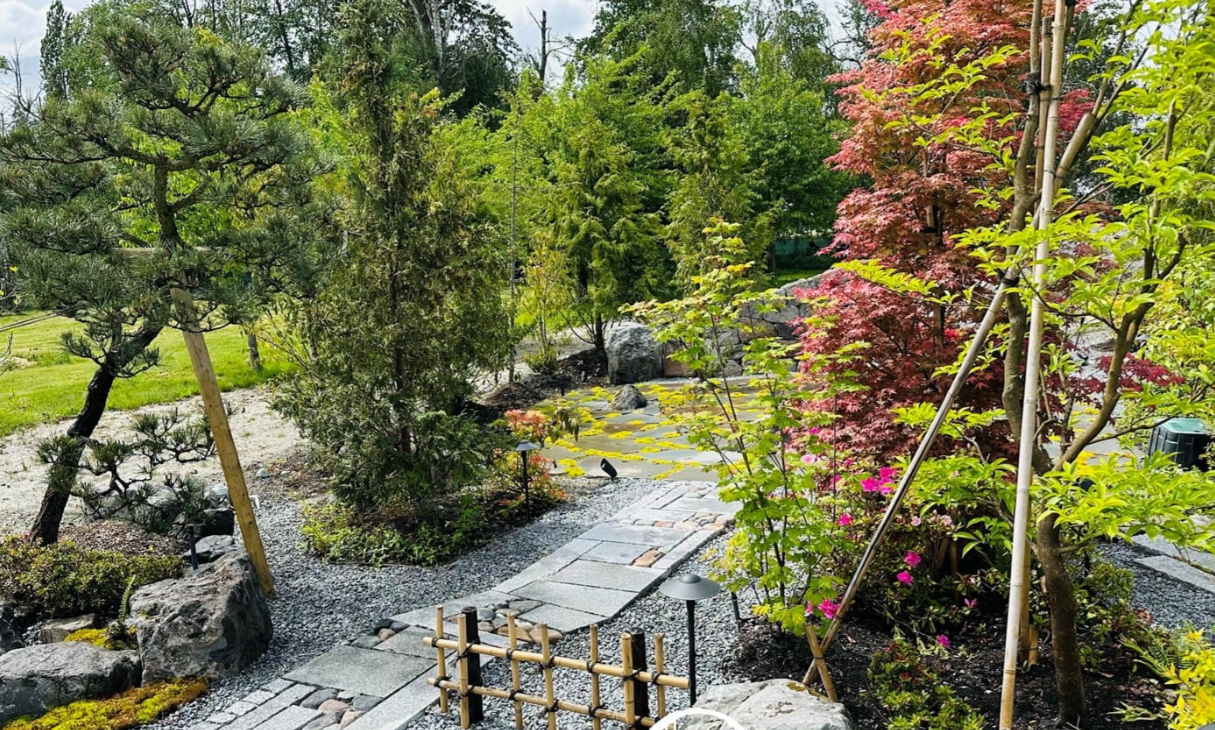
Vancouver offers plenty of places to slow down outdoors, but its Japanese gardens occupy a category of their own. Rather than impressing visitors with scale or abundant flowers, they work through restraint—arranging stone, water, and greenery so that a limited space feels deep, unhurried, and quietly alive.
Nitobe Memorial Garden is the best-known of these, and for many Vancouverites, it serves as a first genuine encounter with Japanese garden culture. Walk through it slowly, and you notice that the calm you feel is not an accident. It is designed.
This article uses Vancouver’s gardens as a starting point to explore how Japanese gardens work: what to look for, why they feel so tranquil, and how their underlying ideas can inform the design of a modern home garden or outdoor space.
Why Japanese Gardens Resonate in Vancouver
Part of the answer is simple geography. With the ocean, the mountains, and an abundance of parks close at hand, spending quiet time outdoors is woven into daily life here. A Japanese garden fits naturally into that rhythm—not by showing nature at full scale, but by distilling it into a composed, contemplative space.
There is also a cultural dimension. For many visitors, Nitobe Garden offers a Japanese perspective on nature, framing it, welcoming seasons instead of resisting them, and shaping a walk as carefully as a view. In a city where many cultures coexist, Japanese gardens have taken root as part of the local landscape—places that connect culture, nature, and stillness in one setting.
Nitobe Memorial Garden: Where Tradition Comes to Life

On the grounds of the University of British Columbia, Nitobe Memorial Garden is widely regarded as one of the most authentic Japanese gardens outside Japan. What makes it worth an unhurried visit is not any single feature, but the way the whole composition unfolds as you move.
There is no one spot from which the garden is meant to be seen. The pond appears, disappears behind foliage, and reappears at a different angle. A bridge changes your height and your view at once. Scenery is revealed in sequence, a little at a time, so that the walk itself becomes the experience—less like viewing a picture, more like being led through one.
This is why pausing matters here. Stop on a bridge and watch the water. Notice the deliberate emptiness left between the trees, or the view that opens only at the end of a path. Nitobe rewards the visitor who treats it as a place to linger rather than a route to complete—and in doing so, it demonstrates the core ideas of Japanese garden design better than any explanation could.
How to Read a Japanese Garden

The shifting views at Nitobe are not happy accidents. Every element in a Japanese garden—and just as importantly, every gap between elements—has a job to do. Knowing what those jobs are changes how you see the garden.
Stone, Water, and Planting Each Play a Role
Garden designers do not place anything in a Japanese garden purely for decoration.
Stones anchor the composition. A large stone gives the scenery weight and stability, a fixed point around which everything else settles. Water does the opposite: it brings movement and depth, reflecting the trees and sky and changing the garden’s expression throughout the day.
Planting is handled with the same intent. Trees are chosen and pruned for how their height, branching, and layered foliage shape the visitor’s line of sight—not simply to add greenery. Leaf colour, the form of a trunk, the way a species changes through the year: all of it is part of the design, well beyond the showiness of flowers.
What matters is never how much any single element stands out, but how naturally it settles into the whole. Once ask what role each stone or tree is playing, the scenery reads differently.
Paths That Guide the Eye
A Japanese garden is choreographed. Where you enter, the order in which you walk, where you are nudged to pause—these are design decisions, and paths and bridges are their instruments. A curve in the path delays a view; a bridge delivers it. A slight change of angle can transform how a familiar stone or tree appears.
So as you walk, pay attention not only to what is in front of you but to where your eye is being sent next. What waits at the end of this path? What is being deliberately withheld? Walking is not how you get through the garden. It is how the garden is meant to be read.
The Seasons Are Part of the Design
A Japanese garden never shows the same face twice. Spring brings fresh green and blossoms; summer’s deep foliage casts shade and settles the mood; autumn adds colour; winter reveals the architecture of bare branches against evergreens. Light, water, and even the feel of the ground underfoot shift throughout the year.
None of this is treated as a problem to manage. Change is welcomed as part of the garden’s character, which is why a single visit only ever shows you one chapter. If you visit Nitobe in spring, come back in November—you will find a different garden on the same ground.
The People Behind Vancouver’s Japanese Gardens
A garden this deliberate does not maintain itself, and the story of Vancouver’s Japanese gardens is inseparable from the people who have built and tended them—above all, the Japanese Canadian community.
The region has long been home to gardeners and organisations devoted to the craft. The Vancouver Japanese Gardeners Association, for example, has played a significant role in passing on the techniques and philosophy of Japanese gardening locally, helping extend the tradition beyond a few famous sites into public facilities and community spaces.
Transplanting a garden culture is never a copy-and-paste exercise. A different climate, different plants, different land, and different daily lives all reshape what a garden can be. Vancouver’s Japanese gardens are rooted in Japanese tradition but have been adapted to the West Coast environment, which makes them, in a proper sense, works of cultural exchange. Knowing who sustained a garden, and how the community came to embrace it, adds a dimension to any visit that scenery alone cannot provide.
Where the Stillness Comes From

Walk through a Japanese garden, and you feel a kind of ease that has little to do with size or splendour. Two design principles account for most of it.
Harmony, Not Emptiness
The stillness does not come from the space being empty. It comes from calibration: every element is placed so that none asserts itself too strongly against the others. Too much competing for attention, and the eye cannot settle; too little, and the garden loses its depth. Japanese gardens live in the balance between the two, alternating places that draw the eye with places that let it rest, so the scenery acquires a quiet rhythm.
That balance extends past the garden’s borders. The surrounding trees, the visible sky, the distance to nearby buildings, even the pace of the people walking through—all of it feeds the impression. Stillness here is an ensemble effect, produced by many elements settling naturally into place together.
Time as a Design Material
The second principle is an unusual relationship with time. Moss thickening on stone, branches slowly taking shape, foliage turning—these signals that the garden was never meant to be finished. People tend it continuously, and it changes continuously, and they accept both as part of what the garden is.
This differs from the instinct to keep a garden perpetually new and pristine. These gardens do not rush their visitors because people treat characters that deepen with age as an asset. They offer nothing that demands immediate attention—only things you notice gradually, given time. That generosity with time is what the stillness ultimately rests on.
Bringing These Ideas Home
You do not need expansive grounds or a formal garden to apply any of this. A public garden and a residential yard differ in scale and purpose, but the underlying principles—organising sightlines, leaving deliberate space, choosing materials for their role, working with the seasons—translate readily to everyday outdoor spaces.
The key is to resist the urge to replicate a famous garden in miniature. Even a small yard or courtyard can be made calmer by thinking through a few practical questions: What is seen from the main window? How does the approach to the front door unfold? Where do neighbours’ sightlines fall, and where does the shade sit? Often, simply choosing a single focal point for the eye changes the character of the entire space. Deciding what to reveal, what to conceal, and where to leave room matters more than adding plants.
In Vancouver, local conditions have to shape the plan as well—heavy rainfall, drainage, how shade moves across the lot, which plants will thrive, and how much maintenance is realistic. Applying Japanese garden design ideas here means adapting them to this environment, not importing a Japanese garden wholesale. If you want that quality of quiet in the outdoor space of a home or business, one practical route is to consult a designer who understands both the tradition and the local climate—someone who can translate the principles rather than copy the forms.
Seen this way, a Japanese garden is not only something to admire on special occasions. The stillness you experience in a public garden can become a working reference for your own yard or storefront—provided you start not from a checklist of Japanese-style features, but from how you actually want to spend time in the space.
Living Link Between People and Place
Japanese garden designs in Vancouver offer more than beautiful scenery. They carry a way of engaging with nature, a method for creating calm, and an acceptance of time and change—cultural depth that reveals itself gradually to anyone willing to meander.
They also carry history. The gardens exist because generations of gardeners, many from the Japanese Canadian community, built them, tended them, and passed the craft on. A garden like Nitobe is not simply Japanese scenery placed abroad; it is a cultural space that the local community has protected and kept alive.
And the ideas do not stop at the garden gate. Organising what the eye sees, leaving space deliberately empty, letting the seasons do their work—these are perspectives that can enrich any home or outdoor space. Encountering a Japanese garden in Vancouver is a way into Japanese culture and an invitation to reconsider the spaces closest to you. That double role—connecting people to a distant tradition and to their own surroundings at once—is what these gardens do best, and what they will quietly keep doing.