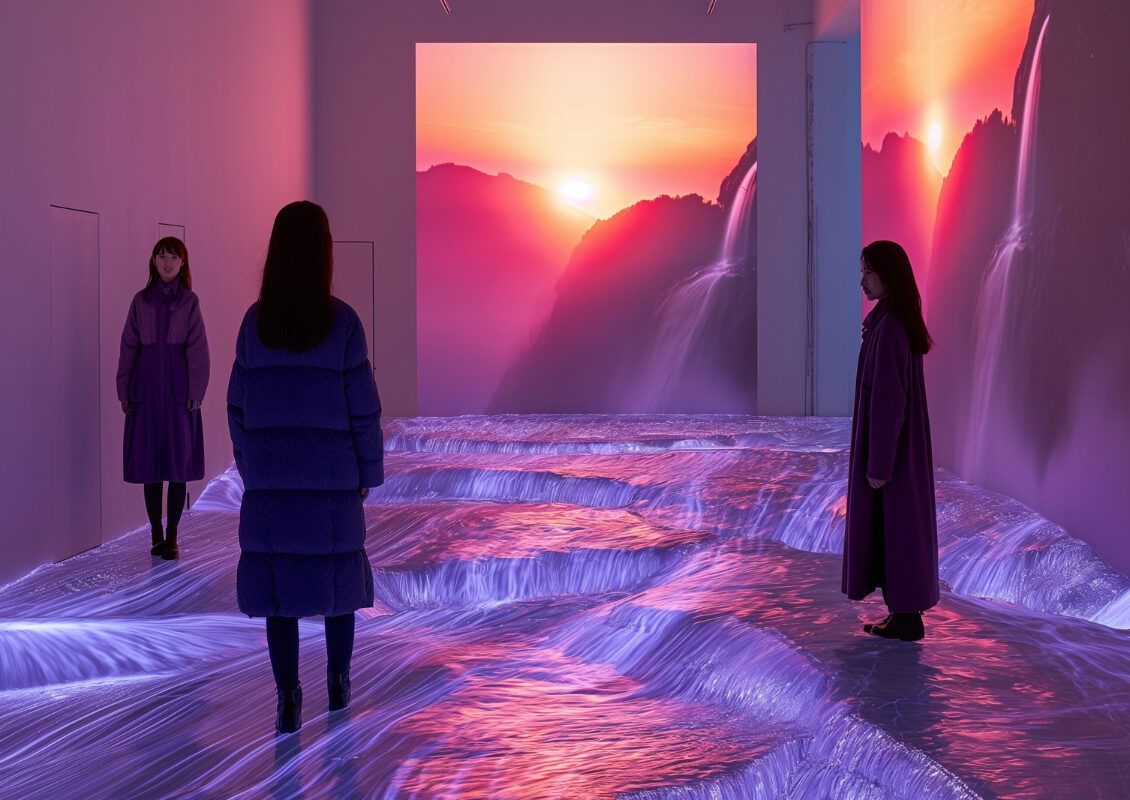
You walk through a doorway, and the floor disappears. Not literally — but visually, luminously, it becomes a mirror of the ceiling above, which is itself a slowly shifting field of projected light, and suddenly you aren’t sure where the room ends and where you begin. Flowers bloom under your feet and dissolve when you step on them. Koi drift past your ankles. The person beside you reaches out to touch a glowing orb and the ripple moves through the entire room, then through you.
This is what happens inside a teamLab installation, and no amount of description quite prepares you for it. Photographs help, but only just. Video helps more, but still misses the way the art responds to your presence and makes you feel that you are participating.
Japan has always been a country where aesthetic experience is taken seriously. What the broader wave of immersive digital art venues have done is bring that seriousness into the twenty-first century. In a form that has captured the attention of travelers from every part of the world. Tokyo is home to two of significant immersive art destinations on the planet, and both are reasons to book a flight.
Further Reading: 5 Surreal Destinations You Have to See in Japan
teamLab: The Studio That Redefined What Art Can Do
Before talking about the venues, it helps to understand what teamLab actually is. Founded in Tokyo in 2001 by Toshiyuki Inoko, teamLab is an interdisciplinary collective of artists, programmers, engineers, mathematicians, and architects who describe themselves as “ultratechnologists.” Their aim is to explore the relationship between humans, nature, and technology through art that is experienced with the body rather than just the eyes.
The philosophical underpinning matters more than it might seem. teamLab is not simply making pretty light shows. Their installations are built around specific concepts drawn from Japanese aesthetic philosophy. The dissolution of boundaries between self and environment. The experience of continuity between the human body and the natural world. And the idea that beauty is a living process to be moved through. When you understand this, the installations shift from spectacular to genuinely meaningful.
The technology is extraordinary. Custom projection mapping systems, real-time rendering, motion sensors, and interactive interfaces. These allow hundreds of visitors simultaneously to affect what they’re seeing. But the technology is always in service of an experience rather than the point of one.
teamLab Borderless: The New Chapter at Azabudai Hills
The original teamLab Borderless closed its Odaiba location in 2022 after attracting more than 2.3 million visitors in its first year and being named by Time magazine as one of the world’s greatest places. What replaced it is larger, more ambitious, and situated in one of Tokyo’s most significant new developments.
Azabudai Hills, the landmark mixed-use complex in Minato-ku developed by Mori Building, positions the new Borderless as its cultural anchor. The venue covers approximately 9,000 square meters across multiple levels. It is a labyrinthine network of interconnected spaces with no fixed pathways, no maps, and no prescribed sequence. You wander. You discover. Artworks spill between rooms, following you or leading you, and the experience is genuinely different every time you visit.
The “borderless” concept is structural. The artworks are not contained in individual rooms but flow continuously between spaces. The installation you enter while turning a corner is connected to the one you left several rooms ago. The whole environment functions as a single living work rather than a collection of separate pieces. It is one of the few genuinely non-linear art experiences available anywhere in the world at scale.
Booking in advance is essential — and not just advisable. The new Borderless location sells out regularly, often weeks ahead of peak travel periods. The official teamLab Borderless ticketing page is the only reliable source for accurate availability and pricing. Tickets cannot be purchased at the door.
teamLab Planets: Water, Immersion, and the Body’s Edge
While Borderless asks you to wander, teamLab Planets in Toyosu asks you to slow down. The experience is more focused, more physically intimate, and in some ways more intense than its counterpart. It has built a devoted following among people who have visited both. They’ve found Planets the more emotionally affecting of the two.
The Planets concept centers on the body in space. Visitors remove their shoes and socks at the entrance and proceed through a small number of large-scale rooms. Each of the rooms is designed to create a different kind of physical and perceptual immersion. One room is flooded with water to ankle depth, its floor and ceiling mirrored, with projected flowers blooming overhead and below. You wade through it. The sensation is genuinely disorienting in the best possible way.
Another room is filled with what appears to be an infinite field of suspended spheres of light. Another inverts expectations of scale entirely. Placing you inside an installation where your own body becomes a reference point for a space that seems to stretch infinitely in every direction.
The Planets experience takes roughly 60 to 90 minutes. And the smaller number of rooms means the experience is more curated than exploratory. This focus works in its favor: each room feels considered rather than abundant, and the physical components (the water, the darkness, the disorientation of mirrored spaces) create a sensory engagement that purely visual installations cannot replicate.
Planets is located in Toyosu, easily accessible on the Yurikamome line, and, like Borderless, operates a timed entry system that requires advance booking.
Beyond teamLab: Tokyo’s Growing Digital Art Landscape
teamLab is the most internationally recognized name in Japan’s immersive digital art scene, but it isn’t the only one. Tokyo’s digital art landscape has expanded significantly in recent years, with several other venues developing their own distinctive approaches to the form.
The Mori Art Museum in Roppongi — in the same complex as the new teamLab Borderless — periodically features large-scale digital works from both Japanese and international artists, offering a more curatorial context for digital art alongside its contemporary programming. The Naked Museum series, from production company Naked Inc., produces site-specific digital installations at historic venues across Japan, including temples, castles, and traditional gardens — creating a kind of dialogue between ancient architecture and contemporary technology that is uniquely Japanese in its sensibility.
In Odaiba, the former teamLab Borderless site has been reimagined for new programming, and the broader waterfront area remains a hub for digital entertainment experiences. Outside Tokyo, digital art has found particularly interesting expression in rural contexts: the Mifuneyama Rakuen hotel and garden in Saga Prefecture hosts teamLab’s outdoor installation in an ancient park, where centuries-old trees are transformed after dark into luminous, interactive artworks. The effect of encountering this technology in a traditional landscape — where the digital and the natural occupy the same space without obvious tension — is something that stays with visitors long after the visit.
Planning Your Visit: What to Know Before You Go
A few practical notes that will significantly improve the experience.
Timing matters more than you might expect
Both Borderless and Planets are more affecting with fewer people around you — the interactive elements respond to your individual movement, and crowded rooms dilute that responsiveness. Early morning time slots, particularly on weekdays, offer a meaningfully different experience from peak afternoon sessions.
Wear comfortable, dark clothing
Light-colored clothing in highly reflective rooms can disrupt the visual environment and draw attention you may not want. Many regular visitors to teamLab installations recommend dark, minimal clothing specifically because it allows you to blend into the environment rather than stand out from it.
Put the phone down occasionally
The instinct to document is understandable — these spaces are extraordinarily photogenic — but the installations are designed to be experienced with the whole body, and some of the most affecting moments happen when you stop looking through a screen and simply stand still in the middle of what’s happening around you.
Allow more time than you think you need
First-time visitors to Borderless regularly report staying longer than planned, returning to rooms they passed through earlier, and finding that the experience changes as the day progresses and crowds shift.
Japan has always found ways to turn the act of looking into something more than passive reception. In teamLab’s installations, that tradition finds its most contemporary expression — and one of its most powerful ones.
Keep Exploring: Japan’s Most Underrated Cities for First-Time Visitors