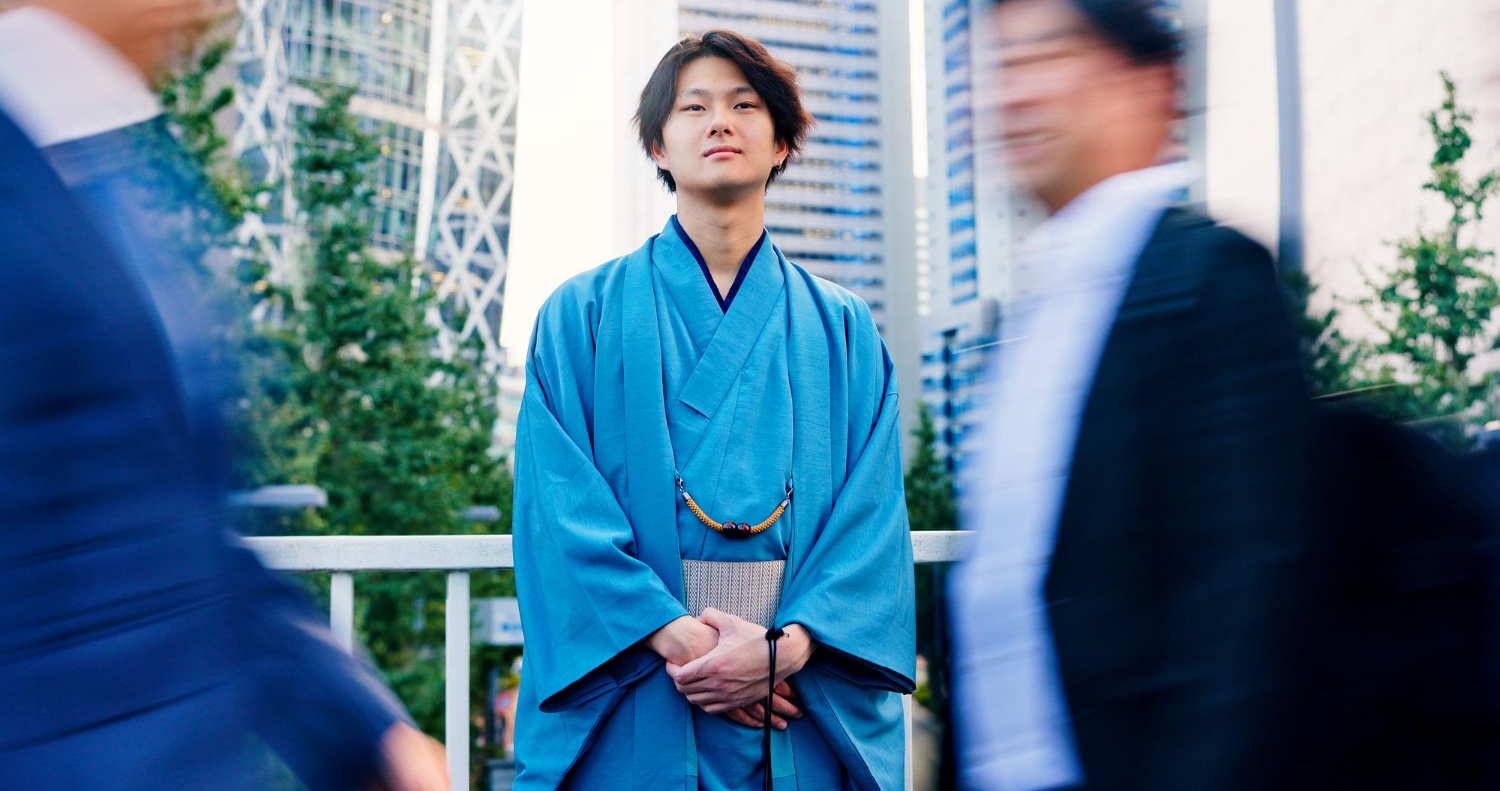
There’s a particular kind of jacket you might notice on a Saturday afternoon in certain neighborhoods of Tokyo or Osaka — well-cut, slightly formal, worn with the kind of easy confidence that suggests it hasn’t just been pulled from a costume box but genuinely lived in. Look closer, and the tailoring is immaculate: a high-twist wool, a structured shoulder, lapels with a slight vintage roll. The man wearing it might be in his thirties, picking up groceries. Or he might be on his way to a sebiro sampo. A “suit stroll” — a street-level social event where people gather specifically to wear, admire, and talk about Japanese vintage fashion and classic tailored suits.
Elsewhere in the city, someone is wearing what appears at first glance to be a beautifully dyed linen shirt in a deep, complex indigo. It turns out to be something more remarkable. A garment upcycled from an old wedding kimono, remade into something that fits seamlessly into a modern wardrobe. No ceremony required. Just a piece of Japanese textile heritage, worn to the supermarket.
Japan’s vintage fashion revival isn’t happening in high-end boutiques or on runway stages. It’s happening at street level, in community events and secondhand markets. Driven by a generation that has decided the best way to honor Japanese craftsmanship is to actually wear it.
Further Reading: Traditions in Japan You’ll Experience Without Realizing It
The Suit Stroll That Became a Movement

The word sebiro is itself a piece of cultural history. It’s the Japanese rendering of “Savile Row” — the London street synonymous with bespoke tailoring. It became the standard Japanese term for a Western-style formal suit during the Meiji and Taisho eras. The classic Japanese sebiro suit absorbed Western construction techniques while incorporating something distinctly Japanese in its fabric quality and the precision of its fit.
Sebiro sampo
Literally “suit strolling” — is a grassroots social phenomenon that emerged from enthusiast communities centered on classic Japanese tailoring. The events are informal: participants gather in a public space and spend time walking together in their finest suits. The point isn’t to go anywhere in particular. It’s to be seen, to see others, to discuss cloth and construction. To normalize that a suit is something you wear on an afternoon rather than reserving it for weddings and funerals.
What makes these events interesting beyond their surface charm is what they represent culturally. Japan’s bespoke tailoring tradition is aging. The master tailors who defined this tradition are in their seventies and eighties. Sebiro sampo events have become a form of living preservation. A gathering that creates visibility and value and introduces younger people to clothing they might encounter only in photographs.
The events have been documented on social media with enthusiasm, helping them spread beyond their original enthusiast base. You don’t need to own a bespoke suit to attend, as there are often vintage ones available for use. The events have created interest in Japanese tailoring, with Tokyo ateliers reporting increases in younger clients inquiring about made-to-measure commissions.
Kimono Upcycling: When a Wedding Dress Becomes a Wardrobe

Japan has millions of kimonos in storage. The occasions to wear them have become increasingly rare. The skills required to dress in them have faded from everyday knowledge. Wedding kimonos in particular often end up stored indefinitely after the ceremony that occasioned them.
A quiet but growing movement
What happens when these garments are unmade and remade? Artisans and small design studios are acquiring old kimonos and transforming them through processes that honor the textile.
The most compelling approach involves natural overdyeing. A silk kimono is typically unpicked at its seams and subjected to natural dye processes that layer new color over the existing fabric. The result is something complex and unrepeatable.
The remade garments take various forms depending on the studio and the source material. Some become structured jackets that retain the weight and drape of silk while functioning in a modern wardrobe. Others become scarves, bags, cushion covers, or the kind of loose shirts that sit at the boundary between clothing and art object. The defining characteristic is always the fabric itself.
What these pieces offer their wearers is unusual. A direct connection to Japanese textile history, without the barrier that makes traditional kimono wearing inaccessible to most people today.
Why This Is Happening Now

The timing of Japan’s vintage fashion revival isn’t coincidental. Several forces are converging simultaneously.
Sustainability is part of it. In a culture that has long valued the concept of mottainai — the regret of waste, the ethic of using things fully before discarding them — the upcycling of old garments carries obvious cultural resonance. Remaking a wedding kimono rather than letting it deteriorate in a chest is a deeply mottainai act, and the word frames it as virtue rather than compromise.
The Heisei-era retro trend, which has been gathering momentum across fashion, music, and design, provides cultural permission to engage seriously with older aesthetics without being seen as eccentric. A generation that grew up in a Japan of rapid change is now actively reaching back for things that feel rooted, specific, and made with care.
And there is something more personal underneath both of these. Japanese manufacturing culture — the ateliers, the dye houses, the weaving workshops, the tailor who learned his craft from a master who learned from another master — is facing a genuine succession crisis. The people who carry this knowledge are aging, and the pathways for passing it on have narrowed considerably. Wearing a beautifully made Japanese garment is, in this context, not just an aesthetic choice. It is a form of attention — a way of saying that this matters, that this craft deserves to continue, that the knowledge embedded in a well-cut lapel or a hand-applied resist-dye pattern is worth preserving.
How to Engage With This Movement as a Visitor
For travelers in Japan, the vintage fashion revival opens up some genuinely rewarding avenues of engagement that go well beyond standard souvenir shopping.
Secondhand kimono markets — held regularly in cities across Japan, with notable ones in Tokyo’s Harajuku and Shimokitazawa districts — offer access to extraordinary textiles at prices that reflect age and wear rather than the original craftsmanship investment. Buying a vintage kimono or obi to bring home, even without the ability to wear it traditionally, is a way of acquiring a piece of Japanese textile history at a fraction of what comparable new fabric would cost.
Several small studios in Tokyo, Kyoto, and Kanazawa now offer workshops in kimono upcycling and natural dyeing — half-day or full-day experiences that result in a remade garment or a dyed textile that is genuinely yours rather than a manufactured keepsake. These workshops fill quickly; booking in advance is advisable.
And if you happen to encounter a sebiro sampo event — which are increasingly listed on community event platforms and local tourism sites — attend if you can, even without a suit. The communities around these events are genuinely welcoming to curious outsiders, and the conversations you’ll find there about cloth and craft and the value of making things well are unlike anything available on a standard tourist itinerary.
Japan’s finest things have always been made to last. The vintage fashion revival is simply the recognition that wearing them is better than storing them.
Keep Exploring: The “Three Ways” of Japan: Tea, Flowers, and Calligraphy Explained